
Why Branding Is Becoming More Important Than Products
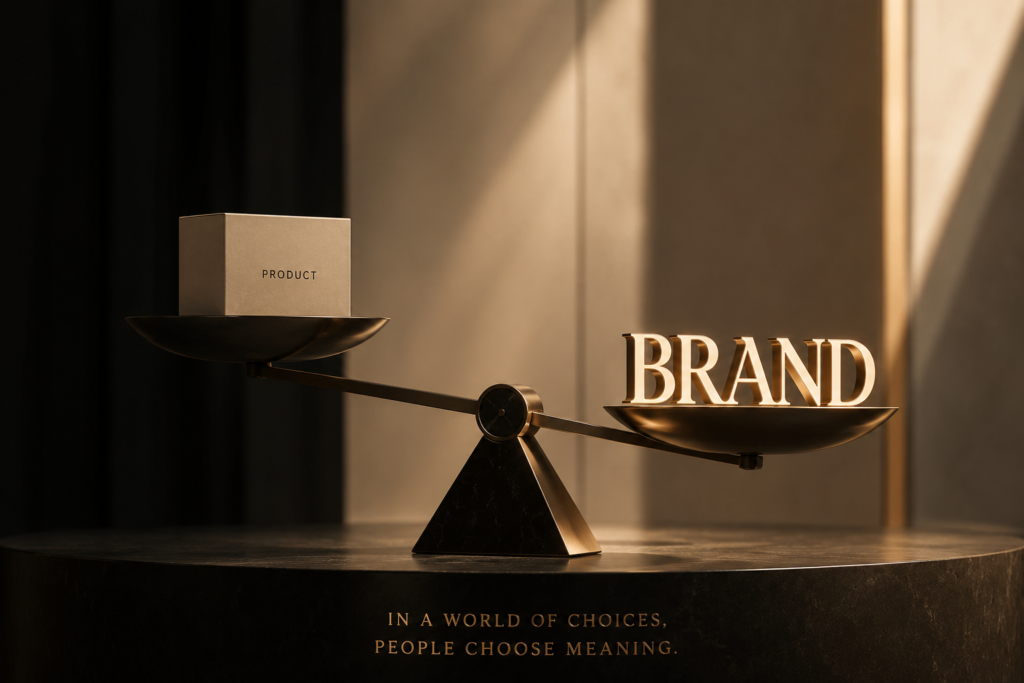
When every competitor can match your features, the only thing that truly sets you apart is what people believe about you.
Not long ago, the path to winning a market was straightforward: build a better product. Superior technology, better materials, and a faster process – these were the foundations of competitive advantage, and they held for decades. That logic still applies, but it is no longer sufficient on its own. “Today, quality earns a brand participation, not distinction.”
“Innovation still exists at scale. The difference is that the barriers to recreating it have collapsed.” The distance between innovation and replication has never been smaller.” In that environment, branding has stepped in to do something a product specification never could; it creates a connection that is genuinely difficult to copy.
“A better product earns a customer. A stronger brand keeps one.”
The parity problem
Explore almost any market from athletic footwear to fintech platforms and you’ll encounter products that differ more in presentation than in practical function. The ingredients are similar. The performance is comparable. The price points converge. And yet some brands in each of those categories command loyalty, premium pricing, and word-of-mouth that their competitors cannot buy, regardless of how much they spend on advertising.
This is the parity problem
When products become interchangeable, the decision shifts from the rational to the relational. Customers stop asking, “Which is better?” and start asking, “Which one is for someone like me?” That is a brand question, not a product question. And it is increasingly the only question that matters at the moment of purchase.
What branding actually does
There is a tendency in business to treat branding as a cosmetic layer: the logo, the colour palette, and the tagline. These are its visible expressions, but they are not its substance. A brand, at its core, is a set of expectations. It is what a customer believes will happen before they have the product in their hands. It is the feeling that precedes the transaction and outlasts it.
That expectation has real commercial value. It shortens the sales cycle because trust is already partly established. It supports pricing power because customers are not purely comparing features. It reduces churn because the relationship extends beyond the utility of any single product. These are not soft metrics; they flow directly into revenue, margin, and lifetime customer value.
“People do not buy what you make. They buy what they expect to feel.”
The strategic shift
Organisations that grasp this reality no longer see branding as secondary to innovation. They recognise that product teams build what is sold today, while brand teams build the conditions under which customers will choose them tomorrow. Neither function replaces the other, but the balance has shifted.
In a world of product parity, the brand is often the last remaining moat. It cannot be reverse-engineered. It cannot be acquired off a supplier list. It is built, slowly and deliberately, through every interaction a customer has with your business, and it compounds in ways that product features rarely do.