
Why Ranking Higher Isn't the Same as Growing Faster
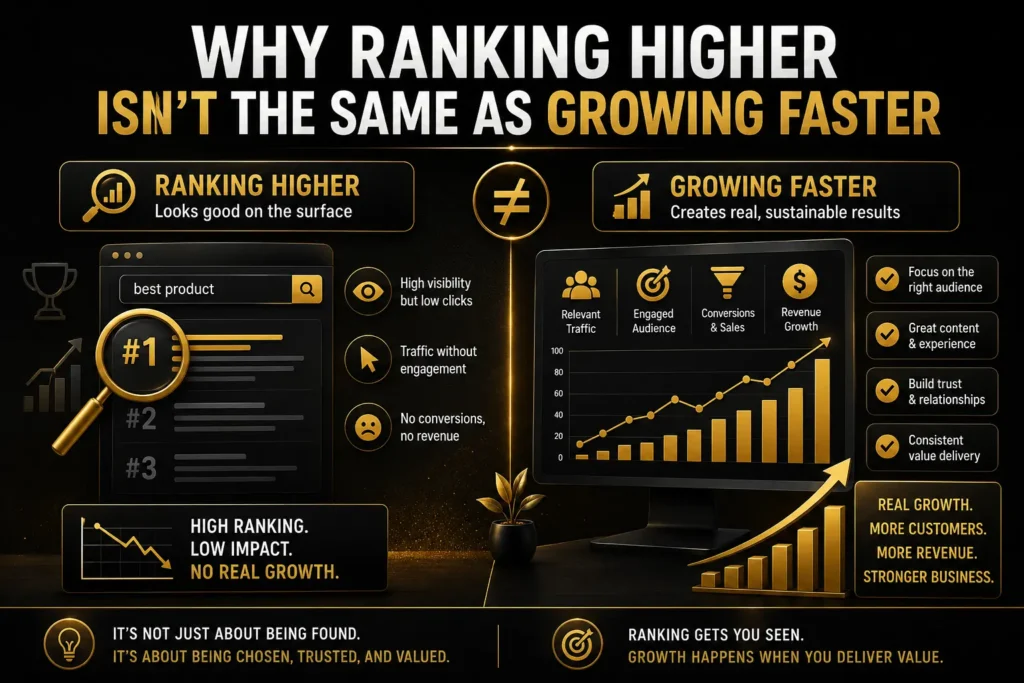
There’s a particular kind of excitement that comes with watching your website climb the search rankings. Page two becomes page one. Position eight becomes position three. The team celebrates, the report looks impressive, and for a moment, it feels like the business is winning. Then the month-end numbers arrive, and the revenue hasn’t moved.
It’s one of the most common and costly confusions in modern business: the belief that ranking higher automatically means growing faster. It doesn’t. Rankings are a signal, not a destination. And chasing that signal without understanding what sits beneath it can lead businesses to invest heavily in visibility while the foundations of real, sustainable growth quietly erode.
The Seductive Logic of the Leaderboard
It’s easy to understand why rankings feel so meaningful. They’re visible, measurable, and competitive. There is something deeply satisfying about seeing your brand above a rival in a search result, a league table, or an industry index. It signals progress. It gives leadership something to point to.
But rankings, at their core, measure one thing: position relative to others at a specific moment in time. They say nothing about what happens after someone finds you, nothing about whether your product solves a real problem, and nothing about whether the customers you attract stay, spend more, and tell others.
A restaurant can top every local dining guide and still struggle to fill tables on a Tuesday night. A law firm can dominate the first page of Google for its practice area and still lose pitches to a smaller competitor that clients simply trust more. Ranking higher gets you noticed. It does not get you chosen, and it certainly does not guarantee you are remembered.
Clicks Are Not Customers
The gap between a high ranking and actual growth lives in a word that many businesses underinvest in: conversion. Specifically, the kind of conversion that goes beyond a single transaction and becomes a lasting relationship.
When someone lands on your website, reads your proposal, or walks into your showroom, they are not yet a customer. They are a prospect making a rapid, often instinctive judgement about whether to trust you. That judgement is shaped by dozens of cues: the clarity of your messaging, the credibility of your testimonials, the responsiveness of your team, and the honesty of your pricing. None of these things is captured in a ranking.
Consider two e-commerce businesses selling the same category of product. One invests aggressively in SEO and paid search, achieving strong visibility and healthy traffic. The other ranks slightly lower but has spent years refining their customer experience: detailed product descriptions, genuine reviews, frictionless returns, and a support team that actually answers. The second business will almost certainly convert better, retain customers longer, and generate more revenue per visitor. Rankings told part of the story. Trust told the rest.
The Growth Metric That Actually Matters
Sustainable business growth is not measured in positions; it is measured in momentum. The compounding effect of customers who return, refer others, and expand their relationship with you over time. This is the kind of growth that rankings alone cannot deliver, because it requires something that algorithms do not reward: earned credibility.
Credibility is built through consistency. It is the sales team that follows up when they said they would. The product that performs exactly as described. The invoice that matches the quote. The apology is issued quickly and genuinely when something goes wrong. These interactions do not trend on social media, but they accumulate into something profoundly valuable — a reputation that makes every future marketing effort work harder.
Businesses that prioritise this kind of credibility find that their cost of acquisition falls over time, because referrals and repeat business reduce their dependence on paid channels. Their rankings may fluctuate with algorithm updates, but their revenue doesn’t, because their growth is not anchored to a position; it is anchored to trust.
Where the Strategy Needs to Shift
None of this argues against investing in visibility or rankings. Being found matters. But visibility is the beginning of the conversation, not the conclusion of it.
The shift that growing businesses need to make is from asking “How do we rank higher?” to asking “What happens after we rank?” That means auditing the customer journey with genuine honesty, identifying where prospects drop off, where expectations are set too high, and where the experience fails to match the promise. It means measuring not just traffic and position, but conversion rate, customer lifetime value, net promoter score, and retention.
It also means resisting the temptation to celebrate a ranking improvement as a growth milestone. It is a visibility milestone, and an important one – but the work to turn that visibility into growth is separate, more demanding, and ultimately more rewarding.
The Real Competitive Advantage
In markets where every competitor has access to the same SEO tools, the same advertising platforms, and the same ranking strategies, what actually differentiates the businesses that grow fastest is not where they appear; it is what people experience when they arrive.
Ranking higher puts you in contention. Trust is what closes the gap.
The businesses that understand this distinction are the ones that build something rankings cannot easily replicate: a loyal customer base that markets on their behalf, returns without being prompted, and chooses them again even when a cheaper or more visible alternative appears. That is not a ranking. That is a growth engine, and it lasts considerably longer than any algorithm update.
Great content! Keep up the good work!
Обновлено сегодня: https://vzyat-zaym-srochno.ru