
Visibility Without Trust Is Just Noise
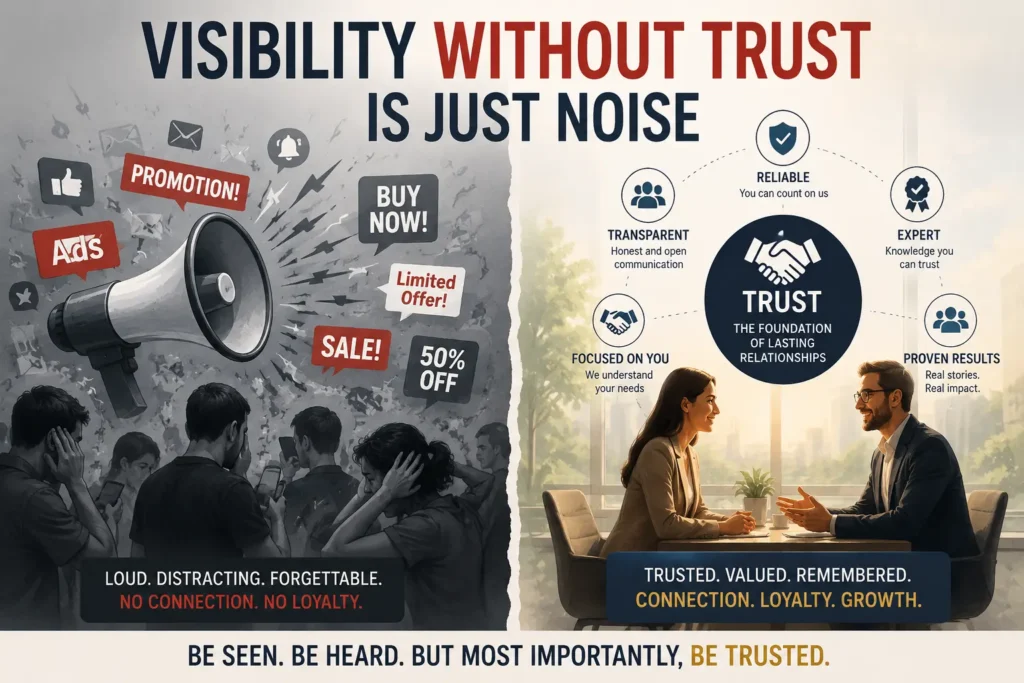
There’s a moment most business leaders recognise: the campaign that reached thousands, the post that went viral, and the brand name that somehow ended up everywhere. Numbers climb. Dashboards glow. And yet, the phones stay quiet, the conversions stay flat, and the partnerships never quite materialise. Visibility, it turns out, is not the same thing as influence. And influence without trust is little more than noise in a crowded room.
In today’s hyper-connected world, the ability to be seen has never been easier or cheaper. Social media algorithms, paid advertising, SEO, podcasts, newsletters – the channels for gaining attention are virtually limitless. But somewhere along the way, many businesses confused ‘reach’ with ‘relationship’. They optimised for eyeballs and forgot about credibility. The result? Louder brands, but fewer loyal customers.
The Illusion of Visibility
Consider the last time you scrolled past an ad for a brand you didn’t recognise. You probably didn’t stop. Even if the creative were clever, something essential would be missing a reason to believe. That reason is trust, and no amount of media spend can manufacture it overnight.
Visibility creates an opportunity. Trust converts it.
A brand can be everywhere – on billboards, in your inbox, across your social feeds – and still feel like a stranger. Familiarity is not the same as trust. We’re familiar with plenty of things we don’t rely on. Think about the financial services firm that runs glossy television spots promising “your future, secured”, while its customers report poor service and hidden fees online. The visibility is there. The trust is not. And increasingly, the customers aren’t either.
The distinction matters because trust is the bridge between attention and action. Without it, even the most visible brands are simply adding to the background hum that people have learned, quite expertly, to ignore.
What Trust Actually Does for a Business
Trust is not a soft, feel-good concept; it is a commercial asset with measurable value. Research consistently shows that consumers are willing to pay more for products from brands they trust, recommend those brands without being asked, and forgive the occasional misstep more readily. These are not small advantages. They are the difference between a business that survives and one that compounds its growth year after year.
Take the example of a boutique accountancy firm that rarely advertises. Its clients are a mix of SMEs and high-growth startups; almost all arrive through referrals. Why? Because over years of honest advice, transparent fees, and proactive communication, the firm built something that no advertising budget can buy quickly: a reputation that precedes it. Word of mouth is simply trust in motion.
Contrast that with a competitor that invests heavily in digital marketing, runs webinars, posts daily on LinkedIn, and consistently appears at industry events. The visibility is impressive. But if the client experience doesn’t match the promise, if the advice is generic, the communication is slow, or the billing surprises clients, that visibility becomes a liability. Every new person who sees the brand is one more person who might hear a cautionary tale from a former client.
Where Businesses Go Wrong
The most common mistake is treating trust as a downstream outcome of visibility, something that naturally follows once enough people know your name. It doesn’t work that way.
Trust is built through consistency, transparency, and kept promises. It accumulates in small moments: the proposal delivered on time, the difficult conversation handled with honesty, the product that does exactly what the website said it would. These moments don’t make headlines, but they make customers.
Businesses also underestimate how quickly trust is damaged. A single misleading claim, an unresolved complaint that festers publicly, or a tone-deaf response to criticism can unravel years of credibility. In the age of online reviews and social media, the audience for those failures is vast. Ironically, high visibility makes this risk greater, not smaller; more people watching means more people witnessing the stumble.
The practical implication is clear: before investing in visibility, invest in the substance that visibility will expose. Get the product right. Train the team. Build the internal culture that makes delivering on promises the default, not the exception.
Building Trust at Scale
None of this means that visibility is unimportant. It absolutely matters; you cannot build trust with people who have never heard of you. But visibility should be earned and amplified by trust, not used as a substitute for it.
The businesses that do this well tend to share a few habits. They communicate with candour, not just confidence. They showcase real customer stories rather than polished brand narratives. They respond to criticism publicly and constructively. They say no to the wrong clients rather than overpromising to every prospect. And they measure success not just by reach but also by retention, referrals, and reputation.
The Quiet Power of Being Believed
In the end, the most powerful thing a business can be is not the most visible; it is the most believed. Belief drives loyalty. Loyalty drives growth. And growth driven by trust is the kind that compounds quietly and proves remarkably difficult for competitors to replicate.
Visibility gets you in the room. Trust is what keeps you there.
So before you ask “How do we get more people to notice us?”, ask the more important question first: “When they do notice us, what will they find?” Build the answer to that question with integrity, and the attention will follow and actually mean something when it does.