
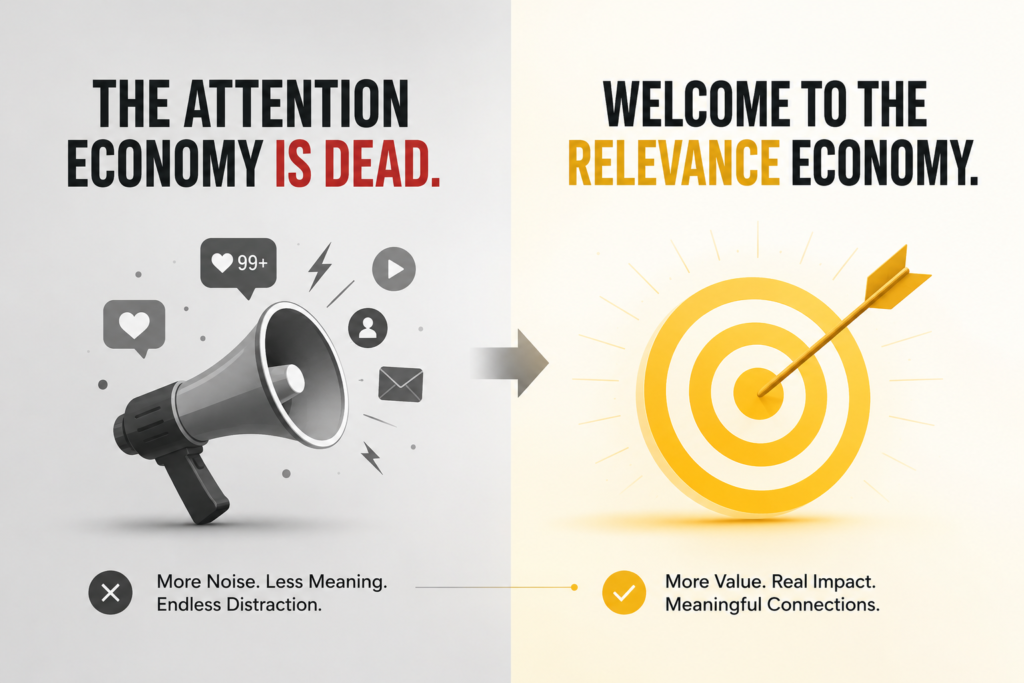
The Attention Economy Is Dead. Welcome to the Relevance Economy.
01
For the past two decades, the dominant playbook in marketing and business growth has been deceptively simple: grab attention. Run the biggest ad. Go viral. Shout louder than everyone else. The theory was that whoever captured the most eyeballs would win the most customers. But here is the uncomfortable truth — that playbook is broken, and the brands still clinging to it are paying for reach while losing relevance.
02
Today’s consumers are not just distracted — they are overwhelmed, sceptical, and brutally selective. The average person is exposed to over 10,000 brand messages every single day. They have developed an almost immune response to undifferentiated marketing: banner blindness, ad blockers, skip buttons, and the reflexive scroll past anything that feels generic. Attention without context is just noise with a budget, and consumers have stopped paying the price of their time for noise.
“Attention is no longer a competitive advantage. Relevance is.”
03
This shift has given rise to what strategists and marketers are increasingly calling the ‘Relevance Economy’ — a business environment where success is determined not by how many people you reach, but by how precisely your message, product, or experience fits the specific needs, values, and moment of the person you are reaching. In the Relevance Economy, the brands that win are those that can answer one question better than anyone else: why does this matter to this specific person, right now?
04
Netflix is perhaps the clearest example of relevance engineered at scale. The platform does not just recommend shows — it builds an individual taste profile for every user and even customises which thumbnail image it displays for the same title because the visual hook that resonates with a thriller fan differs from the one that connects with a romance viewer. The product is identical; the relevance is personalised. The result is one of the highest customer retention rates of any subscription business on the planet.
05
But relevance is not a strategy reserved for billion-dollar tech companies. A local bakery that sends a birthday discount to loyalty members is practising relevance. A B2B software company that triggers onboarding emails based on what a user actually clicked inside the product is practising relevance. A consultant who shares a case study only with prospects from a specific industry is practising relevance. In each case, the brand is doing one disciplined thing: delivering the right value to the right person at the right moment.
06
Building a relevance-first business begins with deep audience understanding — not demographics alone, but behavioural patterns, beliefs, fears, and aspirations. This means investing in ongoing customer research: interviews, surveys, behavioural data, and real feedback loops. Segmentation is the minimum entry point. True competitive advantage comes from knowing your customer so well that your communication feels less like marketing and more like someone finally understood what they needed. When customers feel understood, trust follows — and trust converts at a rate no paid impression can match.
07
Personalisation at scale is the operational engine of the relevance economy. Modern CRM tools, email marketing platforms, and social media algorithms have made it accessible to businesses of every size to tailor messages based on behaviour, preferences, and lifecycle stage. However, meaningful personalisation goes far beyond “Hello, [First Name].” It means matching your communication to where a customer genuinely is in their journey — serving educational content to a first-time visitor, social proof to someone who is considering a purchase, and exclusive value to your most loyal buyers. Spotify’s annual “Wrapped” campaign illustrates this perfectly: it transforms personal listening data into an emotionally resonant, shareable story, and users do not just consume it — they amplify it voluntarily, making it one of the most effective organic marketing moments of the decade.
08
The third and perhaps most powerful pillar of the Relevance Economy is value-first communication. The most relevant thing a brand can do is solve a real problem before asking for anything in return — through education, tools, community, or insight that genuinely helps. Brands that lead with value earn the right to a customer’s time rather than buying it. This approach builds the kind of trust that turns first-time buyers into repeat customers, and repeat customers into advocates who refer others, forgive occasional mistakes, and resist switching to competitors. Loyal customers built on relevance are the most defensible asset any business can hold, because no competitor can simply outspend their way into that relationship.
09
The brands that will lead the next decade are not the ones that scream the loudest — they are the ones that listen the most carefully, understand the most deeply, and show up with value that feels genuinely personal. Attention was always rented. Relevance is earned. And in today’s market, what is earned is what endures. If your strategy is still built around reaching everyone, it is time to rebuild it around serving someone — the right someone, in the right way, at exactly the right moment. That is not just better marketing. That is a better